
On Evaluating AI in Product Companies+
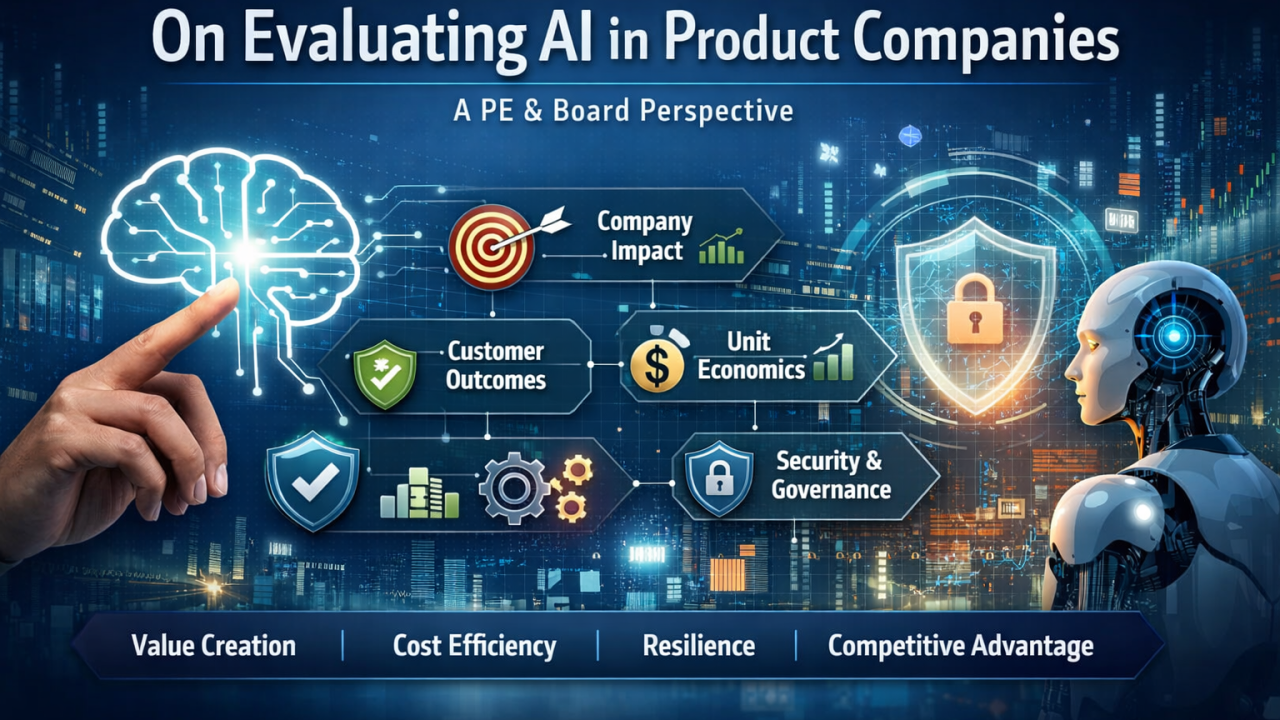
Most AI strategies today are still just expensive R&D.
The real question for PE investors, and increasingly CEOs, is:
Is this AI strategy driving enterprise value, or is it just expensive R&D?
Too many discussions stay at the feature level. The right lens is outcomes, economics, and durability. Here is the 8-part framework I use to evaluate AI inside a business:
1. Customer Outcomes (The “So What for the Customer?”)
If you can’t tie AI in your product to desired customer outcomes, why are you doing it?
Dramatic improvements in customer workflow and throughout productivity
Significant reduction in cost to obtain desired outcomes
Ability to achieve new outcomes not previously possible
2. Company Outcomes (The "So What for the Company?")
Similarly, if you can’t tie AI to a quantified company impact, it’s noise.
Revenue lift: Does it drive higher conversion or win rates?
Efficiency: Does it deflect support tickets or automate complex workflows?
Time-to-Value: Does it slash onboarding from days to hours or minutes?
3. Unit Economics & Operating Leverage
AI must show up on the P&L, not just the roadmap.
CAC Efficiency: Higher conversion and lower cost-of-acquisition.
Margin Protection: Are we trading expensive human labor for cheaper (and scalable) compute?
Sales Velocity: Are we experiencing faster cycles as the product increasingly “sells itself”
4. Pricing, Gross Margin & Value Capture
Don't let the value leak and costs go unmanaged.
Value Units: Are you still pricing by "seat" when your AI reduces the need for seats? Are value units aligned to outcomes (tasks, usage, results)?
Hybrid Models: Moving toward consumption or outcome-based pricing to align with customer ROI.
Gross Margin Targets: What will your AI gross margin be at scale—and what specific levers get you there?
One nuance that is increasingly important: not all AI workloads are created equal. AI agents (vs. simple chat interactions) introduce a fundamentally different cost structure:
- Agents consume significantly more tokens due to multi-step workflows
- They involve reasoning, tool use, code generation, and iterative self-correction
- They often require multiple model calls per task, not just one
As a result, agents are materially more expensive to operate than chat sessions.
If you are moving toward agent-based products:
Your cost structure is no longer linear—it becomes workload-dependent, harder to predict, and easier to misprice.
This is not just a technical nuance—it’s a pricing, margin, and business model design problem.
5. Architectural Resiliency
The model landscape can change dramatically and often (every quarter).
Are you architected to be model-agnostic so that the product can be easily change to different AI stack elements? What is the cost and time required to switch providers or optimize for price/performance?
How quickly can you incorporate new capabilities?
Architectural resiliency is a long-term driver or margin, speed, and negotiating leverage.
6. Security & Governance (The Ceiling)
Weak security will cap your TAM. Enterprise customers won't touch "black box" AI without:
Clear data lineage and auditability.
Zero-leakage guarantees across prompts, APIs, and model interactions.
Strong controls across prompts, APIs, and model interactions
Defined governance around model behavior and data access
7. AI-Native Operating Model
The best companies are AI-native across all business functions, not just features.
Is AI accelerating R&D velocity?
Is it automating GTM (RevOps, lead gen, personalization)?
Scaled customer success with less human intervention
The goal: a structurally more efficient company, not just a smarter product.
8. Durability (The Moat)
In a world where everyone has access to the same LLMs, where is the defense?
Proprietary Data: Do you have a feedback loop others can't buy?
Workflow Gravity: Are you the "system of record" that is too painful to rip out?
Ecosystem Lock-in: Integration depth that AI wrappers can’t replicate.
Value Vectors: Are you building value in the model layer (which is commoditizing), or in the data, workflow, and application layers (which are durable)?
If it’s not durable, it will be competed away.
The Bottom Line
It’s not about whether you’re using AI.
It’s about whether AI is:
Driving measurable outcomes
Improving unit economics
Creating durable advantage
