
The AI Efficiency Signals That Matter
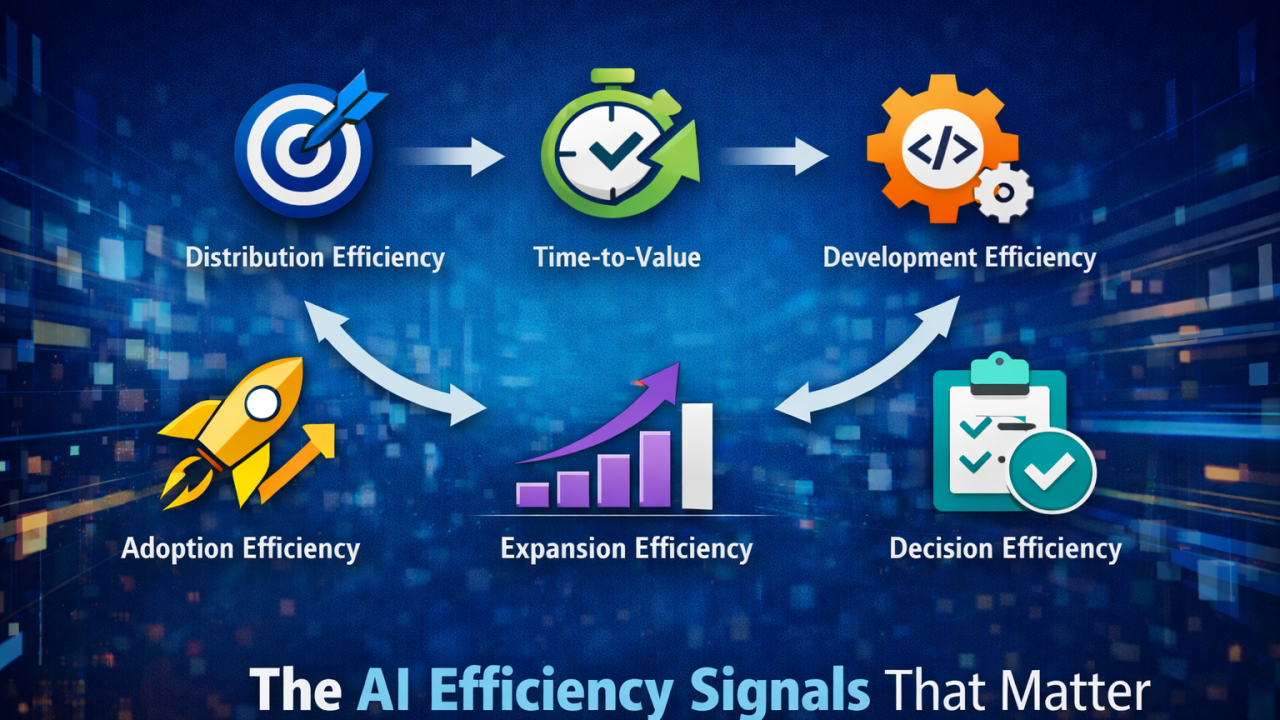
Companies are growing. AI investment is accelerating. Product velocity is higher than ever.
And yet — many leadership teams feel less confident about durability than the numbers suggest.
The reason isn’t growth. It’s efficiency, but not efficiency in the traditional sense.
For a long time, efficiency mostly meant cost control: improve margins, reduce CAC, slow hiring. That definition made sense when software economics were predictable and scale reliably followed distribution.
That world is changing. Today, the companies pulling ahead are not simply the ones growing fastest — they’re the ones converting time, capital, and product effort into customer value more efficiently.
What matters now is value conversion efficiency.
Here are the areas I see increasingly separating durable companies from fragile ones.
1. Distribution & GTM Efficiency
Distribution used to be about reach. Now it’s about precision. AI tools have lowered the cost of outreach and content creation, but they’ve also dramatically increased noise. More pipeline does not automatically mean more adoption.
The real question is: How efficiently does demand turn into an activated customer workflows and value outcomes?
High-performing GTM organizations reduce friction between sale and real usage — not just acquisition cost. In terms of top of funnel, they are not driven by paid advertising but are leveraging trusted advisors in the form of influencers, affiliates, and thought leaders who have major influence on buyers in their core markets. Secondly, they are deploying AI-driven digital buyer journey motions that drive to personalized and critical product experiences that deliver rapid time to value for prospects.
2. Time-to-Value (For Both Customer and Company) Efficiency
This has become one of the most important — and most underestimated — efficiency metrics.
For customers:
How much time and cost are involved before they experience a meaningful value outcome after trying your product?
For companies:
In general, how much company time and cost does an idea move from concept → shipped product → first customer measurable value outcome?
For a specific customer, much time and cost are involved on the part of the company before the customer experiences a meaningful value outcome after trying your product?
Faster time-to-value compounds retention, expansion, and trust far more reliably than pricing optimization ever will.
3. Development Efficiency
AI is dramatically increasing code output. But more code is not the same as more value. Development efficiency increasingly means:
· Customer value outcome delivered per engineering dollar
· Customer-visible and Company-visible impact per release
· Less internal complexity created for every feature shipped
Many organizations are discovering that while AI accelerates production, it can also accelerate product entropy if priorities aren’t clear.
4. Adoption Efficiency
Shipping features faster doesn’t matter if adoption lags innovation. One emerging gap I see: companies measuring release velocity but not adoption velocity.
Key signal: How quickly do new capabilities become embedded in real customer workflows and deliver value outcomes?
Without adoption efficiency, product speed simply creates complexity customers never fully use and product bloat.
5. Expansion Efficiency
In strong companies, growth increasingly comes from value expanding naturally inside existing customers. Not aggressive upsell motions — but increasing reliance.
You see it when:
Usage expands without heavy sales intervention
Additional workflows activate organically
Customers deepen engagement because outcomes improve
Expansion driven by value is far more durable than expansion driven by packaging.
6. Decision Efficiency
This one is rarely discussed but increasingly visible at the board level.
AI is giving organizations more data, more experiments, and more possibilities — but many companies are actually slowing down because decision systems haven’t evolved.
How quickly can a company:
Prioritize product direction?
Redirect its GTM and distribution strategy?
Adjust pricing or packaging?
Act on customer signals?
Organizational drag is becoming a larger constraint than technical capability.
The Shift
In the AI era, scale rewards conversion efficiency — how effectively a company turns effort into customer outcomes that drive company outcomes.
Growth still matters.
But increasingly, durability comes from how efficiently value is created, realized, and expanded after the sale.
